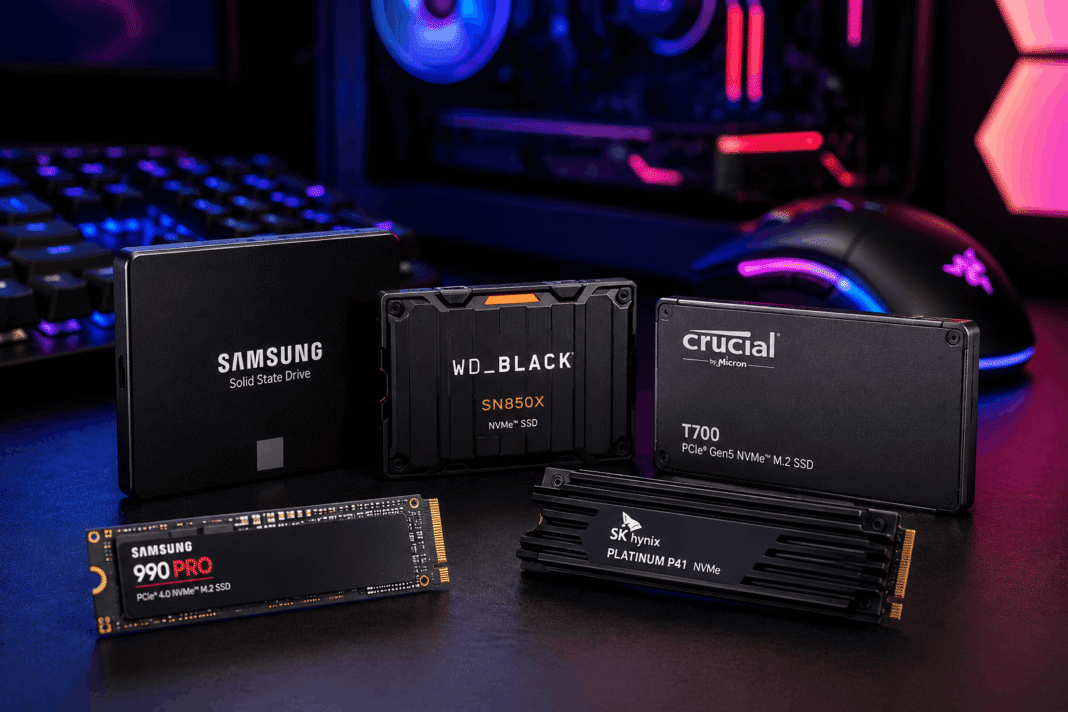
If you’re chasing the best SSD for gaming in 2026, the good news is you no longer have to spend a fortune to get one that noticeably improves your experience. A faster drive won’t boost your frame rate, since that’s the GPU’s job, but it will cut load times, speed up texture streaming in open-world games, and make your whole system feel snappier. With modern AAA titles routinely topping 100GB and DirectStorage now standard in most major releases, storage speed and capacity matter more than ever.
We compared benchmarks and pricing across this year’s top-rated drives to find the best SSD for gaming at every budget, from entry-level NVMe to flagship PCIe 5.0 options.
For more component picks and hands-on hardware breakdowns, check our full gaming gear review archive.
Best Overall Gaming SSD: Samsung 990 Pro
The Samsung 990 Pro remains the benchmark for PCIe 4.0 performance, rated at up to 7,450/6,900 MBps sequential read and write speeds with over 1.2 million read IOPS. It doesn’t chase the newest PCIe 5.0 spec, but it doesn’t need to. For gaming specifically, the difference between this and a pricier Gen 5 drive is close to unnoticeable in real sessions, while the 990 Pro costs considerably less and runs cooler.
Why it stands out:
- Class-leading PCIe 4.0 speeds with excellent sustained performance
- Efficient thermals even during extended play sessions
- Strong five-year warranty backing
Consider instead if: you specifically need PCIe 5.0 bandwidth for creative work alongside gaming.
Tom’s Hardware currently rates the 990 Pro as both the best SSD overall and the best SSD for gaming.
Best Budget Gaming SSD: Biwin Black Opal NV7400
For builders who want NVMe speed without the NVMe price tag, the Black Opal NV7400 delivers sequential read speeds close to the ceiling of what PCIe 4.0 can offer, at a fraction of the cost of flagship drives. A 2TB model runs about $120, which works out to roughly $0.06 per gigabyte, making it easy to stock a large game library without stretching a build budget.
Why it stands out:
- Near-flagship PCIe 4.0 speeds at a budget price
- Excellent value per gigabyte for large game libraries
- No meaningful compromise for everyday gaming performance
Consider instead if: you want the absolute fastest drive on the market regardless of price.
PC Gamer names the NV7400 its top budget pick this year.
Best PCIe 5.0/Fastest Gaming SSD: WD Black SN8100
For players who want the fastest gaming SSD money can buy, the SN8100 leads on performance, thermals, and endurance, with read speeds up to 14,900 MBps. It’s a genuine step up over PCIe 4.0 drives on paper, though the real-world gaming benefit is smaller than the spec sheet suggests, since most of that bandwidth advantage shows up in creative workloads and heavy DirectStorage titles rather than typical load screens.
Why it stands out:
- Fastest sequential speeds of any current consumer drive
- Strong thermal management under sustained load
- Includes a Game Mode feature to further reduce latency
Consider instead if: you’re gaming-only and want to put that budget toward a GPU or extra RAM instead, since PCIe 4.0 drives deliver 95%+ of the real-world gaming experience for considerably less.
PC Guide ranks the SN8100 as its top-tested drive for gaming this year.
Best Large-Capacity Gaming SSD: WD Black SN850X
Modern game libraries add up fast, and the SN850X scales cleanly up to 8TB while keeping random read latency low, which keeps load times snappy even as the drive fills up. It’s not the cheapest way to add storage, but if you want one drive to hold your entire library without juggling installs, this is the one to get.
Why it stands out:
- Available in capacities up to 8TB
- Low random read latency even at high capacity
- Reliable performance under heavy, sustained use
Consider instead if: you only need 1-2TB, since smaller PCIe 4.0 drives offer better value per gigabyte at that size.
Best SATA/Secondary Gaming SSD: WD Blue SA510
Not every build needs NVMe. If you’re upgrading an older system without a free M.2 slot, or just want cheap secondary storage for games you play infrequently, the SA510 covers that gap at around 560/530 MBps sequential read and write. It won’t match NVMe speeds, but for a secondary drive or an older rig, it’s a straightforward, affordable fix.
Why it stands out:
- Reliable, affordable option for older builds
- Works well as secondary storage for a large game library
- Simple 2.5-inch form factor fits nearly any case
Consider instead if: your motherboard has an open M.2 slot, since even budget NVMe now costs barely more than SATA.
Quick Comparison: Best SSD for Gaming 2026 at a Glance
| SSD | Best For | Interface | Standout Spec |
|---|---|---|---|
| Samsung 990 Pro | Overall pick | PCIe 4.0 NVMe | 7,450 MBps read, strong thermals |
| Biwin Black Opal NV7400 | Budget | PCIe 4.0 NVMe | $0.06 per GB at 2TB |
| WD Black SN8100 | Fastest/PCIe 5.0 | PCIe 5.0 NVMe | 14,900 MBps read |
| WD Black SN850X | Large capacity | PCIe 4.0 NVMe | Up to 8TB, low latency |
| WD Blue SA510 | SATA/secondary | SATA III | Affordable, universal compatibility |
How to Choose the Best SSD for Gaming in 2026
Match capacity to your library, not the hype. A 2TB drive is the current sweet spot for most gamers, leaving enough room for Windows plus a healthy rotation of installed titles without constantly deleting and redownloading.
PCIe 4.0 is still the smart default. Unless you’re pairing gaming with heavy creative work, a Gen 4 drive delivers nearly identical real-world performance to Gen 5 at a noticeably lower price and with less heat to manage.
Check for DirectStorage support. Most major titles released since 2024 support Microsoft’s DirectStorage API, which lets the GPU pull assets straight from the SSD. This benefits NVMe drives more than SATA, and Gen 5 slightly more than Gen 4, though the difference remains modest for now.
Don’t skip the secondary drive question. If you already own a fast boot drive, a cheaper SATA or lower-tier NVMe drive can handle overflow storage for games you play less often, saving your fastest drive for current favorites.
FAQ
What is the best SSD for gaming overall in 2026?
The Samsung 990 Pro remains the top all-around pick, combining flagship-level PCIe 4.0 speeds with strong thermals and reliability at a lower price than newer PCIe 5.0 drives.
Do I need a PCIe 5.0 SSD for gaming?
Not really. The best SSD for gaming purposes right now is still usually a PCIe 4.0 drive, since most games show only a small real-world difference against PCIe 5.0, typically under two seconds of load time.
How much SSD storage do I need for gaming?
2TB is the current sweet spot for most builds. Modern AAA titles often exceed 100GB, and Windows 11 alone can need 60GB, so 1TB fills up faster than most gamers expect.
Is NVMe or SATA better for gaming?
NVMe is the better default for any new build, since it connects via PCIe and vastly outpaces SATA’s 6Gbps ceiling. SATA still makes sense for cheap secondary storage or older systems without a free M.2 slot.
Does a faster SSD improve frame rates?
No. Your GPU handles rendering, so an SSD’s job ends once a game finishes loading. Faster storage instead reduces load screens, speeds up texture streaming, and cuts stutter in asset-heavy open-world games.
